
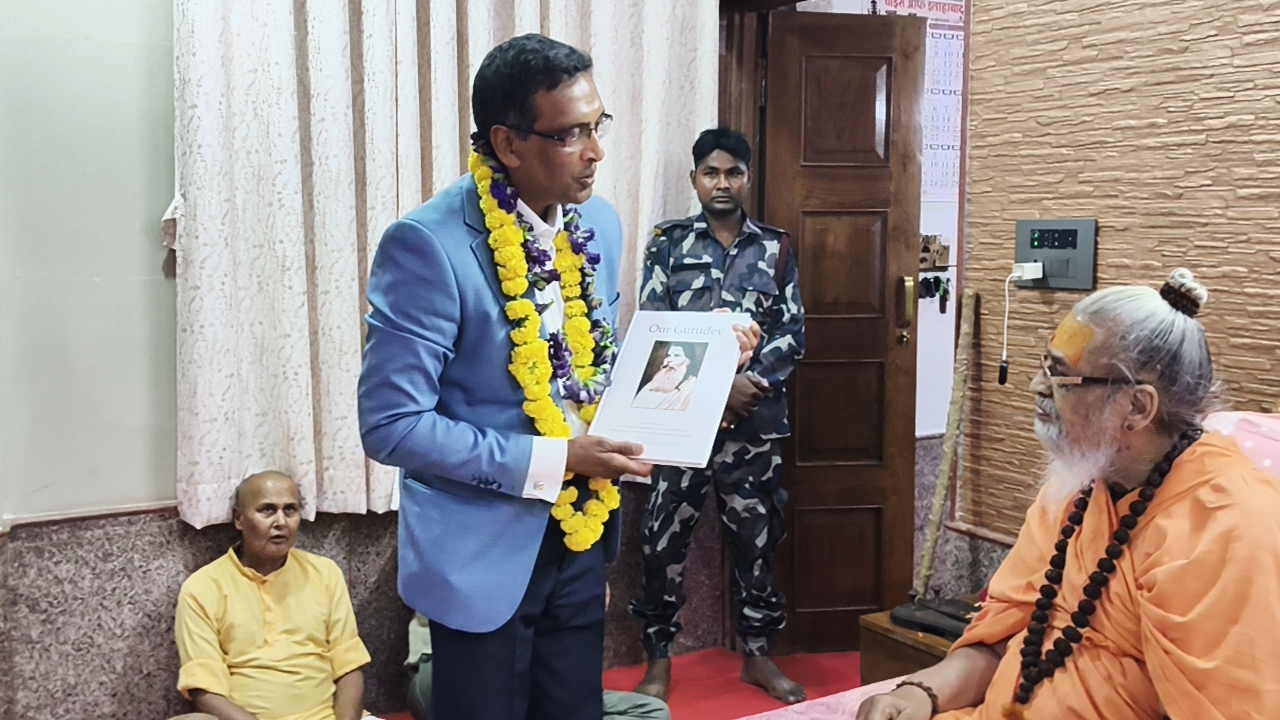
In 1983 Shri Vasudevananda Sarasvati published his biography of Shri Shantananda Sarasvati in Hindi. Writing from great depth of emotion, the biography is a hymn of praise to the sage who has been a great inspiration to thousands. So there was huge demand for an English translation. Read on to hear from Mukesh Bhavan, leader of the Gauteng School of Philosophy who tackled his most challenging translation so far.
WHEN TRANSLATION BECOMES A PILGRIMAGE
Mukesh Bhavan, Gauteng, South Africa,
Starting the translation
It was a student from the School in Ireland who first encountered the biography. Initially, he and a few others arranged privately for a translation in India. This translation was found to have a number of deficiencies, and so it was decided that a fresh translation was needed.
The request for a new translation reached me in 2016. As I began reading the preface and moved into the first chapter, I often found myself immersed in a stream of deeply devotional language so fervent and intense that an entire paragraph would unfold as a single, unbroken sentence. Each phrase was layered upon the next until the long sentences opened into a heightened state of reverence. The effect was not merely descriptive but experiential. I felt the author’s profound love for Shri Shantananda Sarasvati.
My initial reaction was, ‘Impossible!’ – and I knew I needed help. I approached my eldest sister, Savitaben, who had an excellent command of Hindi, having been raised and educated in India. Without hesitation she agreed to help.
We had barely made any progress with the translation of the first chapter when Savitaben was diagnosed with stage four cancer. She immediately had to undergo intense chemotherapy and was no longer able to participate. I had to walk the path alone.

‘Word by word, step by step…’ goes a famous Sanskrit grammar aphorism. It meant rolling up my sleeves and redefining priorities. Except for weekends, 6am to 1pm, I dedicated each day to the work of translating. Gradually whilst endeavouring to use the most appropriate words, the phrases came together. All the while I was attempting to convey the same intensity of devotion I had found in the original text. Sentences began to take form, then paragraphs, then chapters.
It was painstakingly slow but I could not rush the process. I dared not misrepresent the words written by one great sage about another great sage – one who has left such a profound spiritual legacy in his wake both for east and west. The translation had to be correct – there was no room for ‘my’ interpretations of meaning, no room for error. At times I was forced to stop and spend time reflecting deeply on certain sections to try and get into the mind and heart of both the author and subject. This brought forth a deeper revelation which could then be expressed in a more refined way.
Guidance
Whenever I looked back to review a chapter or particular theme, I would get a sense of the deep reverence in the writing. When the words began to shine with meaning beyond the simple translation, it was then that I became aware of the most important contributor – the benevolence of the Teacher. Before I began each day, I would chant aloud the names of the great teachers in the Holy Tradition beginning with Narayanana and ending with the current Shankaracharya Shri Svami Vasudevananda Sarasvatiji Maharaj. It was clear to me that this translation was being guided by them.
Translation becomes a pilgrimage
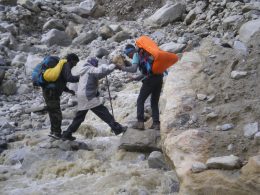
Three years passed, and the translation was almost finished, except for a section which describes the first pilgrimage of Shri Shantananda Sarasvati. Some parts of that pilgrimage were unfamiliar so I checked with my sister Savitaben. She had been on many pilgrimages in India but she too did not recognise some of the places. Then came the decision – we needed to go and see for ourselves. Weeks of planning followed and we eventually left South Africa for the Himalayas in late September 2019. We had just a few weeks before some of the sites officially closed for the tough winter months.
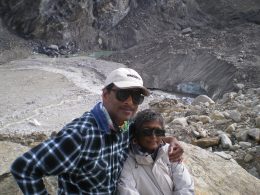
The pilgrimage was challenging. Some terrain required the use of ponies, porters and many a cold night sleeping in sub-zero temperatures in a tent. We also trekked to high altitudes at times, and for many hours a day. Shri Shantananda Sarasvati had done all of this on foot, without any ponies or porters and without any high-tech trekking and camping gear! Savitaben was amazing, now recovered from the intense chemotherapy and having received the “all clear” only months before we began the pilgrimage! Her perseverance and determination were awe inspiring, and the porters were a great help to her. After the pilgrimage, I was able to work on the missing sections of the biography.
Good. But….
The completed translation was presented to the worldwide Leader of the School and also the Chairman of the Jyotir Nidhi Nyasa Trust, a charity supporting the study of Vedic Philosophy. Their comments recognised that it was a labour of love. They also noticed it was populated with numerous detailed footnotes together with many transcribed words using diacritical marks. They rightly commented that the reader might give up after the first few pages, if not sooner!
The translation had to be made accessible, but I dared not assume I could do that myself. It would require someone who was closer to the author and to the subject, someone who understood their teachings deeply. That person was the leader of the School, Mr Donald Lambie. Working together, we turned each chapter into a more readable, more satisfying form.
Publication of Translation
Many people from the School of Philosophy contributed to the completion of the translation. Students in England and Gauteng took on the Sanskrit texts. Gauteng students also assisted with the design of maps, annexures and other such editing and formatting.
The publication was delayed for a long time by those who had been entrusted to review the translation. But in March 2026, we received permission, and thanks to the efforts of those concerned, ‘Our Gurudev’ was presented and distributed during the auspicious occasion of Guru Purnima (Teachers’ Day) at the School of Philosophy in London in the summer of 2026.
The Final Destination
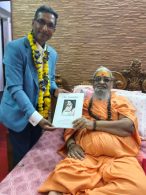
On 14 September 2026, I presented a copy to the author, His Holiness Shri Vasudevananda Sarasvati. He was extremely delighted and conferred many blessings to all those involved. The life story of his beloved teacher could now be shared with the English-speaking world.
Immediately thereafter, I called Savitaben and with euphoric joy described the delight that I had witnessed from His Holiness. I was also able to tell her how deeply impressed His Holiness had been at her participation in the pilgrimage. Savitaben was overjoyed. These were the last words we exchanged. She breathed her last a few days later, having unexpectedly succumbed to illness whilst in India preparing for one last pilgrimage. Mr Lambie, in acknowledging her contribution to the biography, described her as ‘daughter of spiritual India’.
End Note
I cannot take any credit for the translation of the biography. It was the blessings of grace and providence that made such an undertaking possible. Grace directed the heart, mind and pen. Providence in its many forms, brought it to fruition. One such form was Savitaben who had funded the entire pilgrimage. May her soul rest in peace.
Enjoyed this article? Read another like this: Miracles at Lourdes