


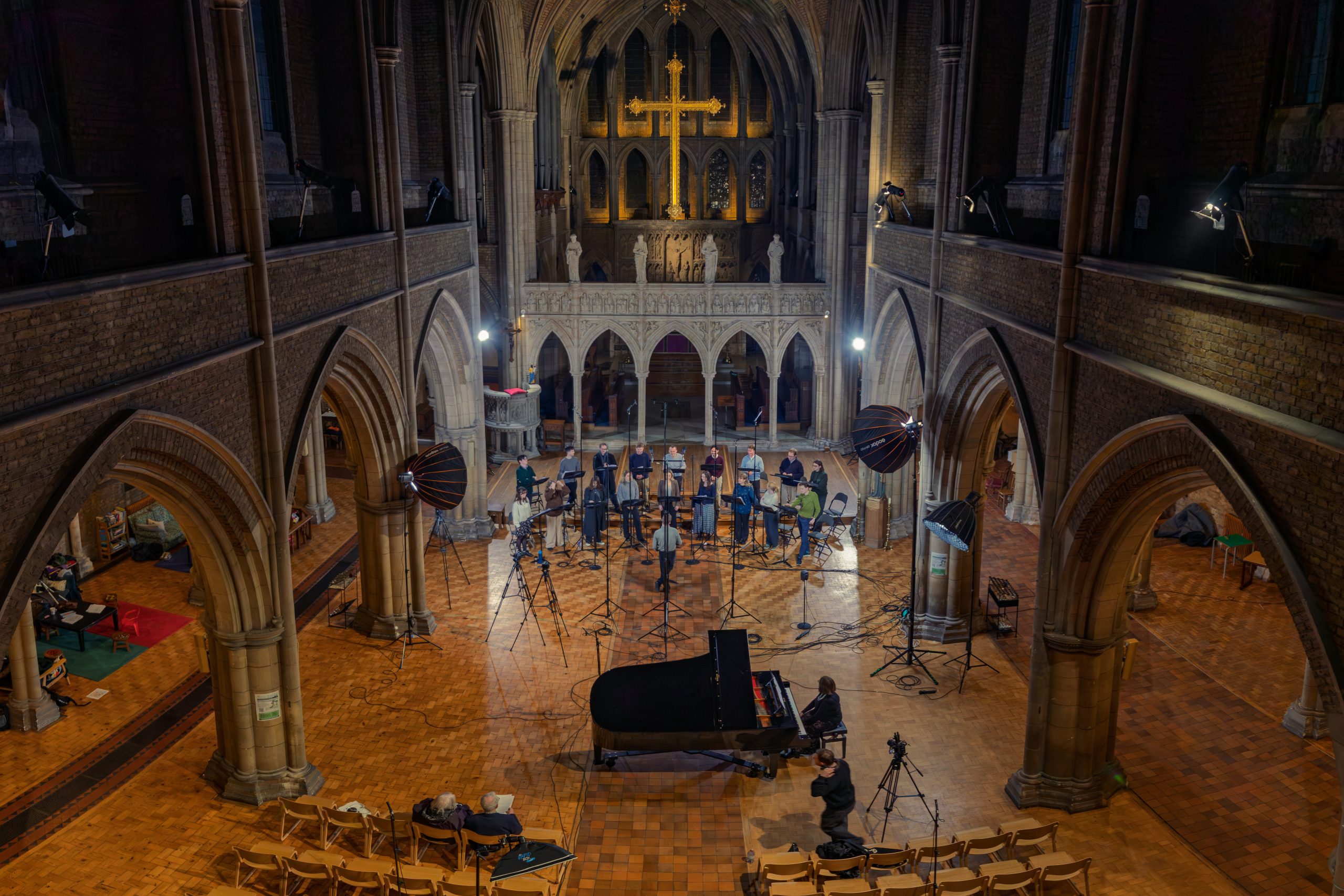
Derek and Adrian recently collaborated in a project to record choral music composed over many years by members of the School of Philosophy in London. Here they each describe their experiences leading up to and including the final production of a CD of Choral Contemplations.
CHORAL CONTEMPLATIONS
Derek Saunders and Adrian Green, UK
Derek has been a member of the School for many years. As an accomplished musician, for much of that time he has been involved with the Music Group. He has conducted several annual music weeks and directed the School choir, Discantvs. He spent 20 years teaching at St. James before taking up a position teaching music at the London Oratory School. Derek is also Director of Music at his local church.
Adrian attended St James School before taking a gap year to teach music at John Colet School in Sydney. After studying for a degree in music, he took the position of Lay Clerk at Portsmouth Cathedral. He established his own record label, Convivium Records a year later. Amongst his many activities, he runs the Music Group at the School of Philosophy.
.
DEREK SAUNDERS (COMPOSER)
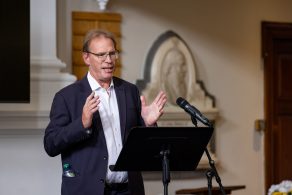
Musicians in the School have been studying the art of composition for many years. It began in earnest following a meeting with His Holiness Shri Shantananda Saraswati in 1971 when Leon MacLaren, the School’s founder, asked about the process of setting words to music. The answer inspired him to complete a major work based on the gospel of St John – In the Beginning was the Word. The advice had been to connect with the words, their meanings and indications and finally the essential emotional import of the text. “This can be found by those who have the experience. Music is expected to do just that.”
Origins of Choral Contemplations
The Composers’ Group was officially formed in the early 1990s, and I was privileged to be part of it. We studied deeply the Conversations of 1971, with Shri Shantananda Sarasvati, together with other references to music. Then we took our compositions for Leon MacLaren along with the other members of the group to hear. The question was always posed – does the music truthfully portray the words, the meanings and the emotional import? Simply hearing the music in such a highly “conscious” situation shone a light on how to take the composition forward and he was often very encouraging.
Emerging Choral Contemplations

From these meetings a number of large-scale works emerged – David Stoll’s Bowl of Nous, David Fletcher’s Song of Solomon and Bruce Ramell’s Gospel of St Thomas. I myself wrote music for various plays that were being produced at that time. At least three performances of New Music were arranged around that time to showcase the work of the group. They were difficult concerts to promote and our performance skills were sometimes not up to the demands of the music. Consequently ‘New Music’ in the School had to take a bit of a back seat.
Just Intonation of Choral Contemplations
Leon MacLaren left us with a treatise on Music and its significance in the spiritual world which we continue to study. In it he presents the notes of the scale in a way that encourages us to hear the tuning of these notes in their ‘natural’ form. He termed it the ‘natural octave’ but today it is called ‘just intonation’. The study of it brings a musician very close to the simple proportion of number in sound. For instance, a perfect fifth on a piano is slightly altered to accommodate all the different keys of the tempered scale, whereas in ‘just intonation’ the proportion that gives us a pure fifth is 3:2. With precise and concentrated practice, the purity of this proportion and all the many that follow can be heard.
Over the years, members of the Music Group have spent many hours studying and practising these beautiful harmonies. This has often resulted in a profound experience of the natural law of sound. Most of the music on the CD is unaccompanied singing so this allows for better tuning of such intervals. Indeed, two or three of the works have been written using pure ‘just intonation’ intervals – you may be able to spot them.
Importance of the Words
In addition, great importance has always been placed on the quality of the words being set to music. Words of profundity and spirituality are purposely chosen. This challenges the composer to find the same depth of experience in his or her own being.
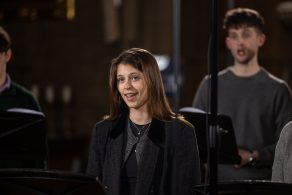
An example of this is my composition Be still and know that I am God (Psalm 46). I had heard the text read in church in the form of a prayer and in the same reductive manner as can be heard on the CD. Immediately I was moved to write, finding the music coming to me very quickly. Indeed the whole process took only a day or two. The key was in listening to what the words were singing. For me that is the crux of the matter. It’s to tap into the beauty of the natural language present in words. Then to reflect that beauty and purity through melody, rhythm and harmony. This is the great joy of the process which is so fulfilling.
The reward of hearing music which has arisen from such study is an experience of happiness rarely reached. It has only increased on hearing the recorded works of friends, past and present, who I have worked with over the past four decades. I am already looking forward to the next steps whilst offering sincere thanks to all those involved in this project.
.
ADRIAN GREEN (COMPOSER AND PRODUCER):
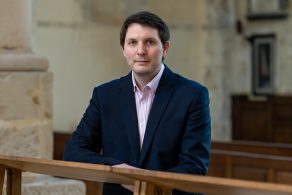
My innate love of singing was cultivated at St James where sometimes we were introduced to new music composed by members of the School of Philosophy in London. For instance, when I was about 7 years old, my music teacher, Noel Skinner, encouraged me to memorise Peter Blumsom’s setting ‘What is Man?’ Later in performing with Discantvs, I became familiar with the work of other members of the Music Group. I was fortunate to know many of them personally. This was formative in terms of my own development as a singer and composer.
A new project: Choral Contemplation
For many years, I harboured an intention to record their music. Despite my being well placed to do so in running Convivium, a classical music label, it felt like the sort of project which would never come to fruition without some sort of external impetus. In September 2025, this turned up in the form of an email.
There was a musical performance for the School Leaders Conference at Waterperry. Following this, Anthony Renshaw, leader of the Sydney School, asked if I might record a setting of “Be Still, and know that I am God”, by Derek Saunders.
The Project Grew
Derek and I felt that it would be an opportunity, and make more financial sense, to record seven songs by seven different composers. All had been inspired by the teaching of Leon MacLaren and had some connection with the Philosophy School. I enthusiastically presented the details and costings to the Sydney School and then to the Executive in London. We received a positive response from both. What came next was unexpected.
A few months before recording, Derek suggested approaching a few supporters of music in the School to help make up the shortfall. Within a matter of weeks our budget increased from £7,000 to about £20,000. We can’t thank those twelve benefactors enough for their generosity.
From seven pieces of music, the programme grew to a full album of nineteen tracks. The recording was to be filmed, produced as a CD album, commercially distributed and reviewed. In conjunction, the score for each piece of recorded music was to be typeset . This is now freely available for others to peruse and perform.
Into production: Choral Contemplations
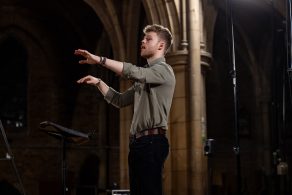
With enough money raised, a choir was appointed for the project. It was imperative that the chosen choir and director would be enthusiastic about the music. We found this in Phoenix Consort and Adam Whitmore.
We hired one of the best churches for acoustics, St John’s Upper Norwood, for two days in February 2026. I delighted in being able to produce the sessions in person. Working alongside an engineer, filmographer and photographer meant that we could capture all aspects of the process.
Post production
The ideal solution is to do as little editing as possible to retain a sense of flow. But generally, in refining a project of this scale editing is unavoidable. It’s a balancing act which takes time and input from composers as well as the production team. Our work involved editing together 19 tracks from around 300 different “takes”. Once edited, the music was mixed and mastered in various formats for release. The film, shortly to be made available, was produced from multiple cameras then synchronised to the final mastered audio.
Behind the Scenes
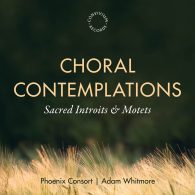
A huge amount of work goes on behind the scenes to elevate the audio product with artwork, distribution, and marketing. It begins with deciding an “album title” which reflects and advocates the music. Then we choose an appealing cover image which balances with the typography. In this project, we probably went through twenty designs before we arrived at a final album cover. The accompanying booklet includes a programme note, texts, biographies and credits, some of which include licensing or seeking permission to reproduce elements of text. Once things are in place, there’s the job of choosing and inserting images to visually elevate the product.
The process of distribution and marketing requires the creation of website pages, music to be uploaded for digital provision, and CD orders to be fulfilled by Convivium. Also PR sheets need to be sent to publications to encourage airplay and reviews whilst planning and preparation is made around social media advertising campaigns.
All this leads up to the launch, which in our case was September 4th, followed by a live concert performance at Hinde St. Church in London the next day. Music scores are now publicly available from Convivium and work is ongoing to encourage and advocate for this music.
What next?
The future is unclear but there are more songs and choral works by composers in the School which we could also record and share. This project has evolved somewhat unexpectedly and in a wonderful way, but it has required patronage as well as enthusiasm to get it over the line. The impact that it has had already on the performers and artists involved and on our audiences is extremely encouraging. The hope is that this music will provide an impulse to others to engage with fine music and support the arts.
Read some of the amazing reviews: Choir and Organ. More reviews on Convivium’s website
Music scores are also available on Convivium.
We are most grateful to the many donors who contributed to this enterprise. They include the School of Practical Philosophy in Sydney, The School of Practical Philosophy and Meditation in New York, as well as many generous individuals. Thank you, you have made all this possible.
Watch the videos of all pieces on this CD. Search also for this album on Spotify and Apple Music.
Listen to the piece which initiated the whole project: