


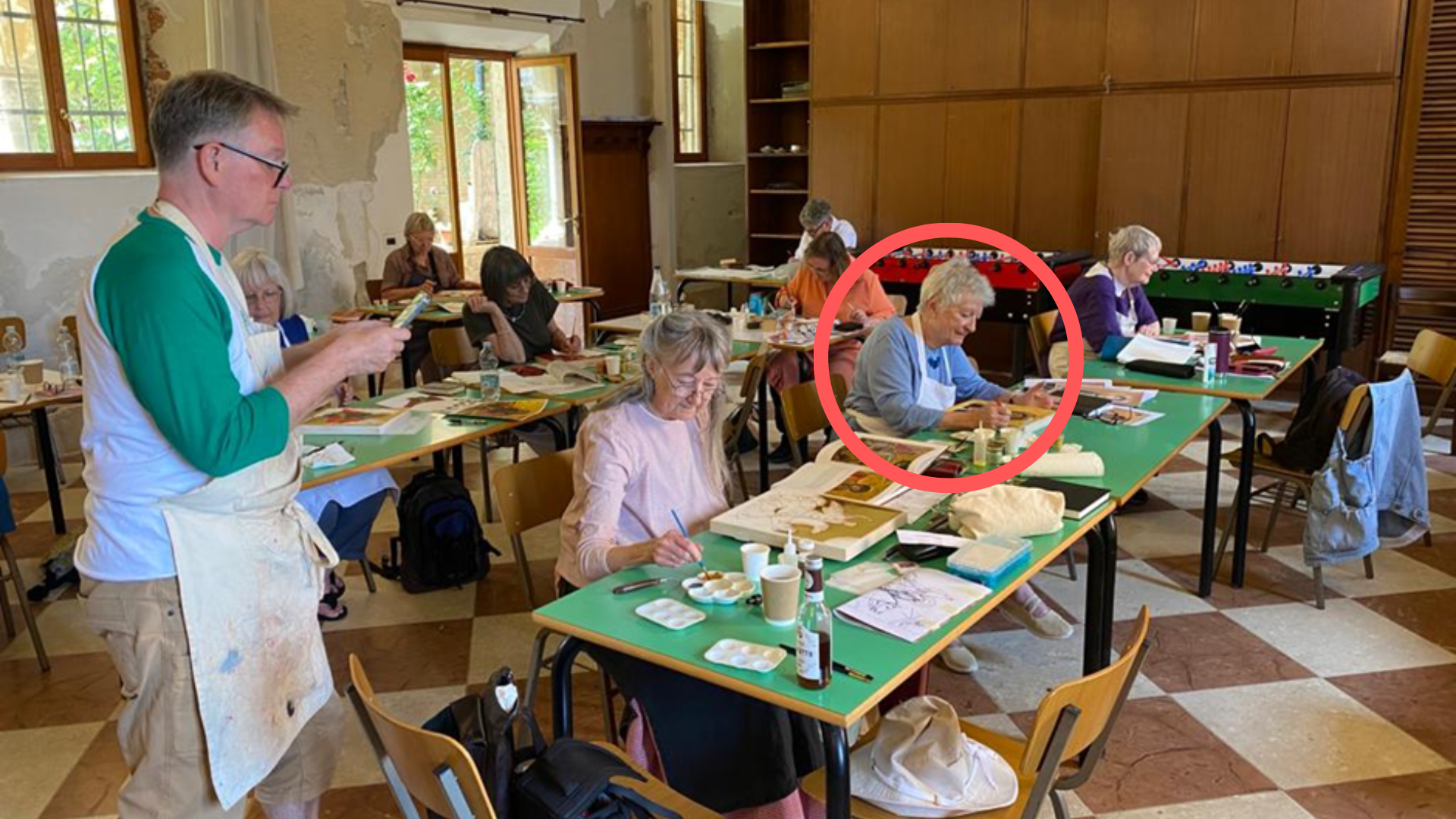
Verena’s professional work involved translating Dutch, German, French and English. At Art in Action, the School’s large arts festival, she and her husband used to organise the section for Russian Arts where Robert developed a love of icons. Later she took the next step in learning how to write icons. Read on to discover where that has led her.
Translating the Imperceptible: Writing Icons
Verena Watson, UK
Waking up to writing icons
It started with an explanation and demonstration of Russian icon painting at Art in Action. My husband Robert was instantly enamoured. We bought that icon, hung it facing East as it should be – and for a while I ignored it. It didn’t look like my image of Christ.
Then one day whilst saying the Lord’s prayer, that image of Christ arose very clearly in mind. It was my first experience of the power of an icon. I experienced its presence and energy in the heart. Sometime later whilst reading a book, ‘The Meaning of Icons’, the thought arose “Paint icons”. That same week, at an exhibition, Robert found a leaflet advertising a workshop, quite near our home.
The next step in writing icons
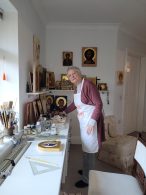
Learning to ‘write’ icons with the Prosopon school was like learning a new language. Following the Russian tradition, we used a lot of Russian names and expressions. Then there was learning about the symbolisms, and the board. Then how to grind pigments and mix them with egg yolk, then wine or vodka as a preservative. Nevertheless, with patience it was relatively easy to produce a good-looking icon. On the course they gave us the design and mixed the pigments for us.
Eventually I had learned enough to attend some of Aidan Hart’s workshops in Shropshire. A well-known English icon painter, Aidan follows the Greek tradition. He is more realistic using bright, often contrasting colours. It’s stronger, some say, than the Russian tradition which is more mystic, expressionist, emotional, using muted colours. Aidan would start each workshop with a lecture. We would copy one of his own icons. It was more demanding but freer – no rules like “never use black”!
A different perspective
One of the techniques to learn was that of ‘inverse perspective’. Since the Italian Renaissance we have been used to looking from our eyes out to a vanishing point in the creation. In other times and in other cultures, (rather than a lack of knowledge) things have been looked at differently.
In Byzantine times, at the beginning of iconography, one did not look out. Instead we let impressions come in. The image was not meant to be looked at but to come into the heart. Furthermore icons depict the heavenly world beyond time and place. Thus chronology is not important, nor is anatomical accuracy.
Why do you say ‘writing’ an icon?
An icon starts with the idea, the name of a saint. This word initiates the ‘writing’; after this it’s the saint’s characteristics, more words. Whereas most Orthodox people have grown up knowing the lives of the saints, I have to do the research. We can recognise each saint by his or her traditional coloured cloak, hair and facial features. These have to be known thoroughly in mind and heart. For example, St Paul’s high forehead, St Peter’s short grey hair and beard, Mary’s purple or blue cloak with three stars to indicate her purity of body, mind and heart.
The name of the saint is the very last thing we write on the board. So the icon begins and ends with a word. This is why we talk about writing an icon. The vibrations which prompt the hand of the painter, then reside in the painting and radiate outwards to connect with the receptive heart of the venerator. Indeed many Orthodox supplicants when praying with the icon at home or in church consider it to be alive and kiss it.
Monastic experience of writing icons
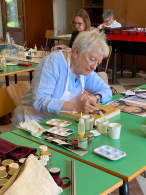
On a friend’s recommendation I joined workshops with a Belgian iconographer, Joris van Ael. We stayed in the guesthouse of the Norbertine monastery in Averbode, east Belgium. After breakfast Joris would start work with a lecture, then we would paint till mass at 11.45am. Then it was lunch in silence with the monks. After washing up, we worked until evensong followed by dinner with the monks. I loved the chanting of the mass and psalms, the simple days living in a loving community. Worldly problems seemed far away.
Often, we continued work in the evening, unless we took a stroll to the ice-cream vendor nearby. The week ended with an assessment of each icon followed by a ceremonial blessing of the paintings by one of the priests, thus making them holy. Far from being simple wall decorations, icons are called doors to heaven, mirrors of the soul. They are created to aid with prayer and contemplation.
Writing icons today
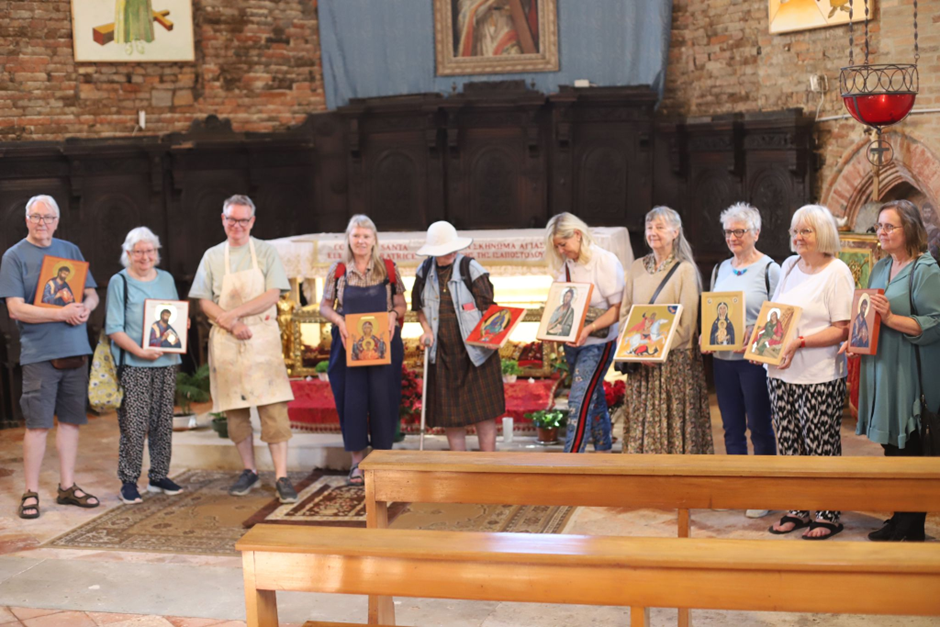
With no formal art training, drawing is difficult for me so I really appreciate the help of a teacher. Guidance comes from Peter Murphy in a Canterbury church where he runs icon courses. One of the loveliest workshops was with Peter in Venice. Every morning we walked to the Santa Elena church in a quiet part of the city. Here we painted from the drawings we had prepared at home. What a joyful experience, writing the Madonna of Victory (looted from Byzantium and now living in the Basilica San Marco), then ending each day with convivial evening meals in local trattorias.
When working at home, my bed disappears into a cupboard and the room becomes my studio. Usually I work flat on a desk. But the next projects, two large icons of Mary and St John the Evangelist I may have to paint on the floor!
Whether at home or away, work on an icon always starts with prayer and sometimes listening to Russian or Byzantine Orthodox chanting. This helps concentration and connects me with the saint I am painting.
The presence of saints
It is said that the famous icon of Our Lady of Vladimir saved Moscow from invaders several times. The Venetians looked to the Madonna Nicopeia (Victory) for protection against the plague and to provide victory in times of war. Many other icons of saints are believed to have powers of healing. Experience has given me a sense of this presence.
While writing the icon of St John the Forerunner, the Baptist as we call him, I first experienced the real presence of the saints. During previous workshops, it had been a joy to paint Archangels Michael and Gabriel but this St John was hard for everyone. All sorts of mistakes happened which were difficult to rectify. We all struggled, including the teacher. Then, on the last day it was as if a heavy blanket lifted and we finally found the peace, which was then shining out of our icons. Reading again my research notes about the saint, I understood that we had experienced some of St John’s difficult life.
Visiting icons
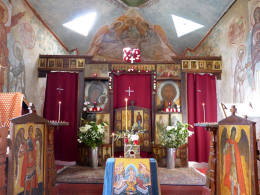
Another occasion was when visiting the chapel of Our Lady of Kazan, south of Paris. A bearded hermit opened the gate. ‘Are you living here alone?’ I asked. He didn’t answer but showed me to the chapel then disappeared. The chapel built between 1940 and 1960 by one man had walls frescoed by Fr Gregory Krug. The simple shapes and muted colours of his figures were imbued with a love that dissolved all comment and thought. In the stillness I sat down to meditate.
After a while, the space became alive with voices – still, small voices but very distinct. I realised that the hermit was far from alone. Jesus, Mary, angels and many saints were all so strongly present there that I could only listen. Now I understood what one of my teachers once said… that the space around us is not empty. It’s full of beings.
The heart of the matter
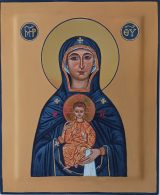
Iconographers refer to a state called hesychasm, a deep stillness of the heart. Whilst engaged in writing an icon there is only unity. The heart is open to the universe through the saint which they are portraying. The saint then guides the hand. When I observe the hand going to a particular pigment and adding another to produce just the right colour, there is only peace and joy. In pondering on the meaning of the icon the answer comes as if from the saint, not in words but as understanding.
Aidan Hart agreed when I suggested that iconography appears to be the act of translating the imperceptible into something visible. In fact, he goes further in saying to his students, ‘Be careful, icons will change your life!’
See one of Verena’s teachers, Aidan Hart on YouTube:
Enjoyed this article? Read another like this: Flutemaker